
Farm to ECE Resource Guide for Early Care and Education Providers
Whether you're just getting started with Farm to ECE or looking to expand your efforts, this guide includes answers to common questions, funding opportunities, and resources to help you incorporate more local foods into your program.
FAQs
I’m new to farm to ece. where should i start?
1
Getting started with Farm to ECE doesn't have to mean changing your entire menu. Many programs begin with one small step and build from there. You might:
Incorporate one locally sourced ingredient into a familiar menu item.
Host a taste test featuring a seasonal fruit or vegetable. Taste tests are a fun, low-cost way to introduce children to new foods and can easily be paired with books, nutrition education, or classroom activities.
Feature one local food each week or month.
Visit a local farmers market or invite a farmer to your program.
Build a relationship with one local producer before expanding your purchasing.
What are the benefits to purchasing local food?
2
The benefits of local food reach beyond nutrition and health benefits, supporting local economies and communities at large.
By purchasing from local producers, more money is kept in your area’s economy. Purchases are supporting small- to mid-size farmers who live and work in your community.
Local food is better for the environment, as it travels a shorter distance to the consumer (you). Local food is also stored for shorter periods, making it not only fresher, but also using less resources. Because it’s closer in distance, local food can often last longer than produce purchased elsewhere, helping save money and reducing food waste.
Local produce is picked at peak ripeness, and delivered to consumers more quickly, meaning local food is packed with flavor and nutrients because it is fresher.
Local farmers and ranchers can tell you information about how their crops or animals were grown and raised.
Programs that participate in the Child and Adult Care Food Program (CACFP) can be reimbursed for local food purchases.
I'm interested in purchasing local foods, but my program is too small to meet minimum order requirements. What can I do?
3
You're not alone. Many early care and education programs don't purchase enough food to meet a farmer's minimum order requirement. Some strategies providers have used include:
Partnering with nearby child care programs to place larger orders
Coordinating purchases with local school districts
Purchasing through food hubs, which aggregate products from multiple farms
Exploring farmers markets or CSA programs that offer smaller purchasing quantities
Talking directly with local farmers about flexible ordering options
Is purchasing directly from farmers more expensive?
4
It depends. While some local products may cost more than conventionally sourced foods, providers have found that building relationships with farmers, purchasing seasonally, and placing larger or recurring orders can help manage costs.
Some programs start small by incorporating one or two local items into their menus and expanding over time as they build relationships with suppliers and learn what works best for their program.
How can I find local farmers and food suppliers?
5
If you're not sure where to start, try:
Local farmers markets
Regional food hubs
State Farm to School and Farm to ECE networks
Many providers find that starting with one local supplier or one locally sourced item is a manageable first step.
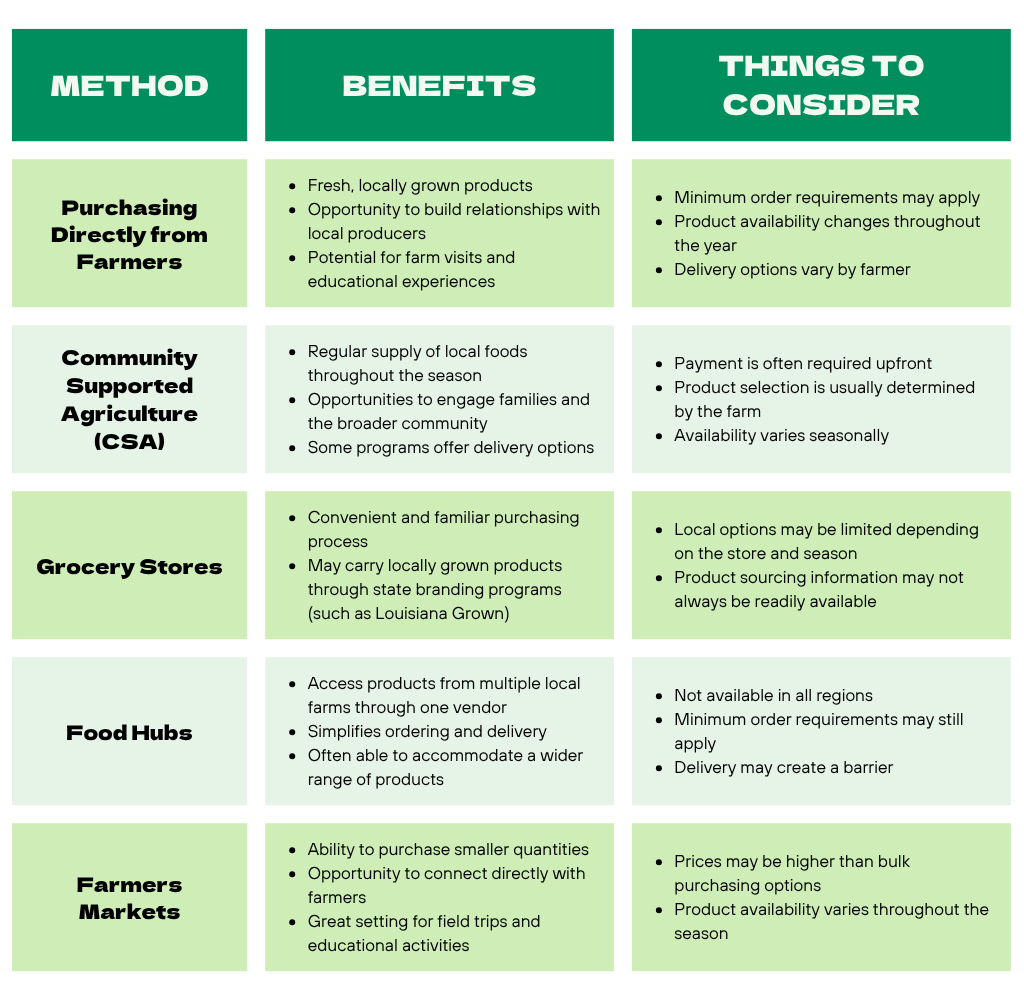
What are my options for purchasing local foods?
5
There is no one-size-fits-all approach. Many programs use a combination of the options below.
Grants and Funding Opportunities
Farm to ECE activities can often be supported through local, state, and national funding opportunities.
-
-
Let's Be Healthy Program (Louisiana Department of Health)
Eligible child care programs may receive:
Up to $2,500 in resources and materials for edible gardens
Small kitchen equipment needed for CACFP participation
Menu Planning and Local Food Resources
Incorporating local foods into your menu doesn't have to happen all at once. Many programs start by highlighting one local item each week or month and build from there.